














This combined sensor-transmitter continuous glucose monitor (CGM) technology offers glucose values every 5 minutes. Sensors last for up to 10-15 days and provide alerts for high and low blood sugars to help keep you in target range.
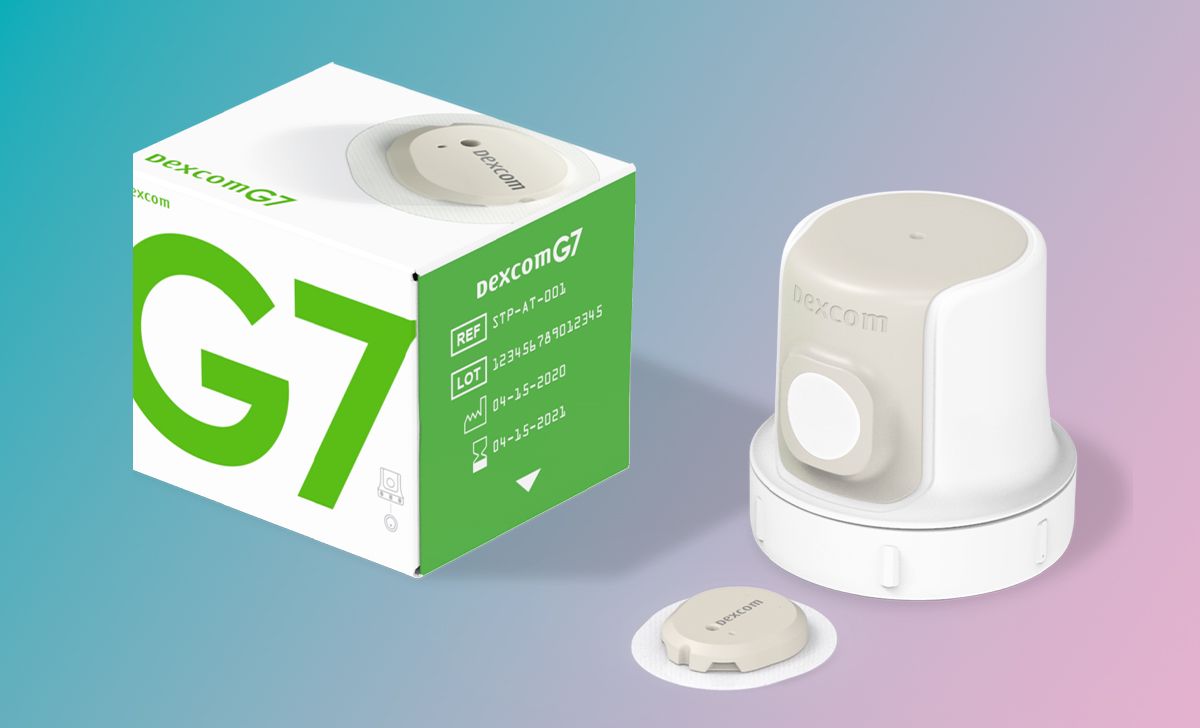
The Dexcom G7 is one of the most advanced continuous glucose monitors (CGM) currently available from the market-leading diabetes tech company Dexcom, which is based in San Diego, California.
Approved by the Food and Drug Administration (FDA) in 2023, the G7 combines its sensor and transmitter into an all-in-one component that measures glucose data for up to 10 days.
The Dexcom G7 is a continuous glucose monitoring (CGM) system that helps people with diabetes manage their glucose levels in real time.
Here are some key features to know about it:
- Function: It continuously measures your interstitial glucose levels (the sugar in the fluid just under your skin) and automatically sends the data to a compatible device (like a smartphone app or a dedicated receiver) every 5 minutes.
- Design: It features a small, all-in-one sensor and transmitter that is worn on the body, typically the abdomen, back or side of the upper arm, or upper buttocks in young children).
- Child-approved: The G7 is cleared by the Food and Drug Administration for both adults and children as young as 2 years old, with all types of diabetes.
- No routine fingersticks: The G7 sensors are “factory calibrated,” eliminating the need for users to set baseline levels with a fingerstick test. While fingersticks aren’t required, you may choose to check the CGM results if you’re feeling ill or diabetes symptoms don’t match the displayed readings.
- Warm-up: It warms up in only 30 minutes, compared to the 2-hour warm-up needed for the earlier G6 model.
- Values and trends: It displays your current glucose value, a trend arrow showing which direction your glucose is moving (up, down, or steady), and a graph that shows your glucose history over time. You can see the past hour along with 3, 6, 12, and 24-hour periods of time.
- Alerts and alarms: It provides customizable alerts for high and low glucose levels, which is beneficial as you can silence some alerts to help prevent diabetes alarm fatigue. A new feature is an “Urgent Low Soon” alert, which cannot be silenced and can warn you up to 20 minutes before severe hypoglycemia of 55 mg/dL or lower.
- Connectivity: The sensor-transmitter uses Bluetooth connectivity to talk with the Dexcom G6 mobile app for both iOS and Android devices, as well as Apple Watch and other devices, including insulin pumps like the Tandem t:slim X2 and Omnipod 5.
- Data-sharing: You can share glucose data with up to 10 designated people (like family, caregivers, or healthcare professionals) using a separate “Follow” app. You can also share data with healthcare professionals using the “Dexcom Clarity” app.
- Other information: In addition to glucose data, you can use the Dexcom G7 mobile app to track other information, including food, exercise, insulin, and other factors that may provide additional context for your diabetes management and blood sugar picture.
Each Dexcom G7 sensor is labeled to be worn on the arm or abdomen for up to 10 days before needing replacement.
It also features an additional 12-hour grace period for replacement. This means that once your sensor expires, you’ll have extra time (as much as a half-day) to replace the G7 before you stop receiving new diabetes data.
The company launched a 15-day sensor in late 2025.
An earlier model (Dexcom G6) is still available, but many people with diabetes are being transitioned to the newer generation, and the G6 is expected to be discontinued in 2026.
The G6 and G7 have different plastic inserters, with the G6 inserter being larger and bulkier than the smaller G7 inserter.
For the G6, a separate transmitter clicks into the plastic-base housing of each new G6 sensor. Each transmitter lasts for about 90 days before needing replacement.
However, a big difference is that the G7 has a combined sensor-transmitter, compared to the G6, which has separate pieces you must buy and use for the CGM to work.
This allows for not only less hardware for the system to work, but it also eliminates the need to get 2 separate prescriptions, insurance approval, and payment for both parts.
People still have a separate receiver available if they’d like, and Medicare does require this even if people choose to use the Dexcom G7 mobile app to view their data.
You insert a G7 sensor using a simple, all-in-one applicator, which has the sensor-transmitter contained inside. Once you press down gently on the skin and push the green button, the small, flexible sensor wire is inserted just beneath the skin.
People who’ve used the G7 often say the insertion is painless, though some have noted they can feel the sensor go into the skin, and it may be more noticeable if it hits a muscle or nerve.
Once inserted, the G7 sensor’s tip sits in the interstitial fluid, which is the fluid just under the skin surrounding your cells. This is different than a fingerstick blood test, which analyzes the glucose in your blood. The G7 sensor uses an enzyme called glucose oxidase to continuously measure the concentration of glucose in this fluid.
The transmitter piece converts this chemical reaction into an electronic signal. It then processes the signal using an internal algorithm to calculate a glucose value, in mg/dL or mmol/L measurement depending on where you live.
The Dexcom G7 is considered one of the most accurate continuous glucose monitors on the market.
Any CGM system’s accuracy is measured using a metric called Mean Absolute Relative Difference (MARD). This is the average difference expressed as a percentage between the CGM’s reading and a lab-measured blood glucose value. The lower the MARD percentage, the more accurate the device is.
Based on the clinical data submitted to regulators, the Dexcom G7’s MARD of approximately 8.2% — the lowest for any non-implantable, real-time CGM currently available.
High accuracy can be particularly important when glucose levels are low or high or when they change rapidly after a meal, exercise, or because of insulin. The G7 is designed to maintain high accuracy during these critical periods, which is vital for making timely treatment decisions.
This is a key reason why CGM technology is considered so important as a way to help people with diabetes keep their glucose levels in range more often.
As someone with type 1 diabetes who’s been using a CGM for more than a decade, I’ve used the Dexcom G7 personally and found it to be an impressive piece of diabetes technology — when it does what it’s supposed to.
It’s not without flaws, though.
Overall, I found it to be mostly accurate compared to the G6 that I also wore at the same time. The results weren’t noticeably different or inaccurate. I very much liked the combined sensor-transmitter design, along with the smaller, thinner, more circular-shaped sensor compared to the G6.
People with diabetes who wear CGM sensors when sleeping often experience “compression lows,” or when they sleep on the sensor and press it too tightly against the skin, so that it inaccurately reads low glucose values. Many of us in the Diabetes Community have been awakened by low alerts, only to find out these were false lows due to how we were sleeping.
With the G7, I found it more compatible with my sleeping habits, and I didn’t have as many compression lows.
I used 3 G7 sensors back-to-back, each lasting for roughly 8-10 days. So in total, I had nearly a month’s worth of hands-on experience under my belt.
However, I also lost 2 other G7 sensors and had to get those replaced with new ones because of manufacturing design flaws that led to failed sensors as soon as I tried inserting them.
Design is the biggest drawback from my view.
While the G7 plastic inserter is smaller than the G6 and allows for more one-handed use, I found it’s a bit clunky and didn’t always properly disconnect the sensor from the inserter.
A couple of the sensors that I tried inserting didn’t take, as they remained attached and wouldn’t come loose. I needed to pull them off my body to remove the plastic inserter. The green part on top of the inserter isn’t firm enough, so when you place it on your skin and try to press the push-button, that button doesn’t always compress because the green part is moving as you press down.
Another issue is a well-known G7 complaint.
The tiny copper wire that goes under your skin doesn’t always stay underneath. In fact, it sometimes pops up through the small hole on the top of the gray G7 sensor, creating what’s dubbed a “goosenecking,” where the sensor wire comes out of the device and cannot properly monitor your glucose levels.
This is a known manufacturing defect, and Dexcom has replaced sensors for those who’ve reported this issue.
The cost of Dexcom G7 depends on many factors, including your medical or prescription insurance and the CGM coverage provided by your particular plan.
Some insurance covers G7 as a pharmacy benefit, meaning you may be able to order G7 sensors at your local pharmacy or through your mail-order pharmacy. Other insurers cover this as durable medical equipment (DME), which is covered by medical insurance and may be tied to a deductible that must first be paid before coverage begins.
The G7 is covered by Medicare for eligible patients, with a coinsurance that can be reduced or eliminated depending on your supplemental coverage.
The retail cost of the G7 is calculated based on monthly supplies (3 sensors per month, as each sensor lasts 10 days).
Without insurance, the average retail cash price for a 3-pack of Dexcom G7 sensors is typically $480 to $570, depending on your pharmacy and location. This would be for a month, though it’s important to remember that not all sensors last the full 10 days, as they’re labeled to last for.
You might also check with the manufacturer, as they periodically offer discounts, coupons, and patient assistance programs.
The Dexcom G7 offers an all-in-one CGM sensor and transmitter to monitor blood sugar levels in real time.
This is smaller and more discreet than earlier CGM systems, and those who wear the technology point to its benefits in helping them stay in target range and better manage their diabetes.
You can discuss the Dexcom G7 and CGM technology, including its benefits and potential concerns, with your healthcare team.