














Stucco keratosis is a type of benign skin lesion that most often develops on the feet and legs. These lesions tend to be more common as you get older.
The name of stucco keratosis is derived from the “stuck on” appearance of the lesions. The rough, sticky appearance is similar to the textured look of stucco. Another name for this condition is keratosis alba.
Read on to learn more about what stucco keratosis is, what it looks like, and what the treatment options are for this condition.
Stucco keratosis is a
The nodules can also form on your toes, ankles, and legs. They’re less commonly found on the thighs and forearms.
Some of the key features that may help you identify stucco keratosis growths include the following characteristics:
- a raised or flat lesion about 1 to 10 millimeters (mm) in diameter
- usually white or gray, but can be yellow or light tan
- dry and scaly, appearing to be stuck to the skin
- more noticeable during winter when skin is drier
- doesn’t fade with time
- doesn’t cause pain or itching
- may slowly grow bigger
- looks different from a mole
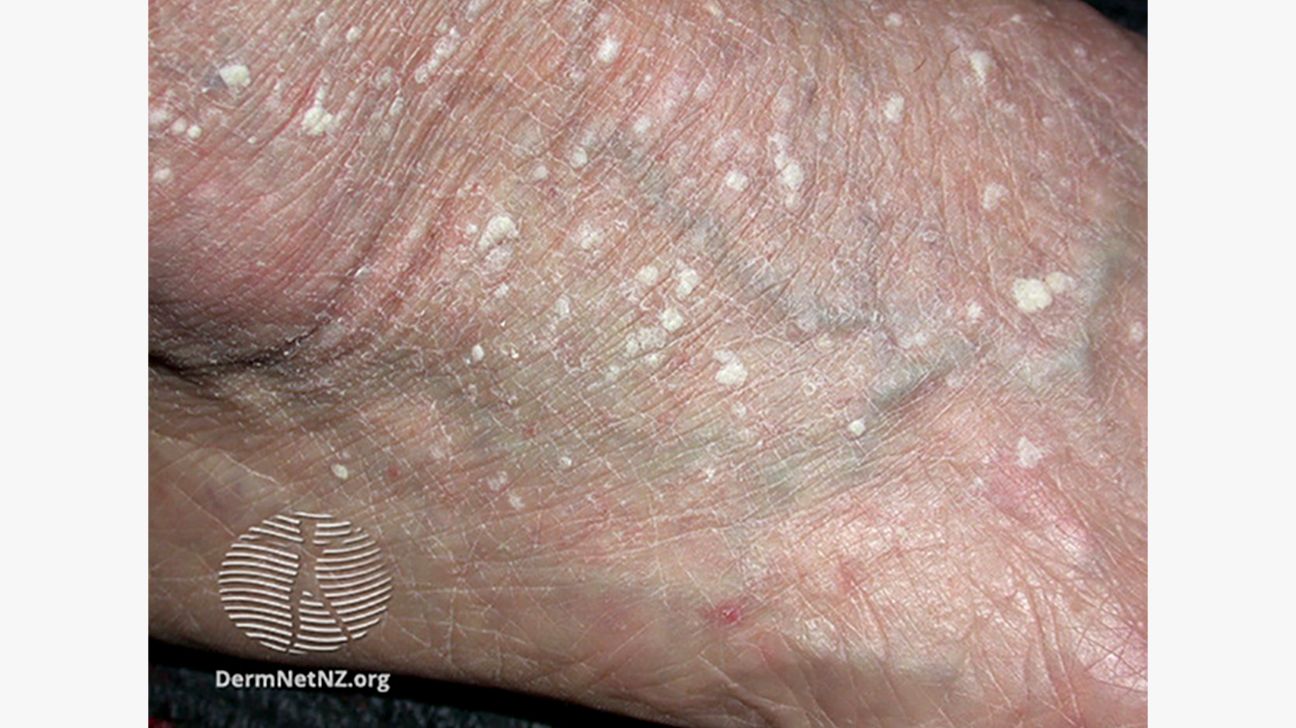
Over time, you’re likely to develop more lesions. Some people have dozens of these nodules, but they can even number in the hundreds.
Stucco keratosis is one of several variants of skin growth called seborrheic keratosis. These are the
There are
- are more likely to be dark brown, black, or a mixture of colors
- are smooth, waxy, or wartlike
- stand alone or in groups
- can be located on the scalp, face, shoulders, back, under the breasts, abdomen, or groin
Anyone can develop stucco keratosis, but it’s
Males may be more likely to have seborrheic keratoses than females.
Generally speaking, stucco keratosis lesions are considered harmless.
They are benign. This means they’re not cancerous, nor will they develop into cancer. They’re not contagious, so you can’t pass them to other parts of your body or to other people.
They’re not likely to cause physical discomfort and it’s not medically necessary to remove them.
However,
Additionally, the lesions can make it easy to overlook other skin problems, including cancerous lesions. So, it’s important to have a dermatologist (a skin specialist) examine your skin regularly to make sure there’s nothing else going on.
The cause of stucco keratosis is unknown. It’s possible that it has something to do with sunlight exposure, but since these lesions don’t usually develop on the face, that’s uncertain.
There’s no clear evidence on what you can do to prevent these lesions from forming.
Stucco keratosis lesions won’t clear up on their own.
A dermatologist can make a diagnosis with a visual inspection.
If there’s any doubt about what the lesion is, they may perform a biopsy. A biopsy is a procedure in which the doctor takes a small sample of skin. The sample is then sent to a lab for examination under a microscope. This can help determine if it’s stucco keratosis or some other condition.
Because the lesions typically don’t pose any danger to your health, treatment usually isn’t necessary. But, if you’re bothered by the appearance, there are some cosmetic treatment options that may help.
Keep in mind that these treatments are not a cure and won’t prevent the formation of new lesions. The treatments may also result in some loss of pigmentation, which will usually be more obvious on darker skin.
Topical preparations
While there are no FDA-approved topical treatments for seborrheic keratoses, you might be able to improve the appearance of lesions with prescription and over-the-counter topical treatments. These lotions or ointments usually contain one or more of these ingredients:
- topical urea
- salicylic acid
- lactic acid
- imiquimod
Freezing
Cryotherapy is an effective method of removing various types of skin lesions.
A doctor will apply liquid nitrogen spray on each lesion to freeze it. It may sting when the liquid nitrogen is applied to your skin.
You might have some soreness over the next few days as blisters develop and eventually fall off.
Scraping
A dermatologist can scrape the lesions off with a sharp razor. This may cause minor bleeding. After the procedure, you may need to apply some form of ointment to air in the healing process.
Due to the risk of infection, this isn’t a treatment you should try on your own.
Surgery
A doctor can perform minor surgery to remove the lesions. There’s no need for general anesthesia or a hospital stay. After injecting a local anesthetic into the area of the lesions, the doctor will use an instrument to remove them.
The procedure isn’t painful and there’s no need for stitches. For the next few weeks, you’ll need to change the bandages every day and apply antibiotic ointment to prevent infection. Any scabs that form will fall off by themselves, leaving minor scarring.
Stucco keratosis is a skin growth that usually appears on the tops of your feet and legs. The cause is not clear, but it’s more likely to develop after age 40 and occurs more often in males than females.
The lesions are painless and noncancerous, so there’s usually no medical need for treatment. If you’d like treatment for cosmetic reasons, there are several options. But there’s no cure and it’s possible that more lesions will develop after treatment.
Having many of these lesions may rarely be a sign of several kinds of cancer, and they can also mask other skin problems. That’s why it’s a good idea to have a dermatologist check your skin regularly.