














Key takeaways
- An SPG block is a procedure where medication is injected near a cluster of nerves behind the nose to treat migraine headaches, particularly when other treatments are ineffective.
- The procedure can be performed in a few ways, including through the nose, mouth, or cheekbone, with the simplest method being through the nose using a cotton-tipped swab or catheter.
- Research suggests SPG blocks can effectively relieve migraine pain within minutes and may also have preventive benefits, though more studies are needed to confirm these findings.
Migraine is a medical condition that affects more than
Doctors usually treat migraine with a combination of preventive medications and pain relievers. While not a typical first-line treatment, doctors may also consider a sphenopalatine ganglion (SPG) block.
The SPG is a cluster of neurons that sits behind your nose and above your mouth. Healthcare professionals can apply a nerve block to the SPG to treat migraine headaches.
Read on to learn more about SPG blocks as migraine treatments and whether they might be helpful for you.
What is the role of the SPG in migraine?
The SPG is also called the pterygopalatine ganglion, nasal ganglion, or Meckel’s ganglion. All of these names refer to the same structure of nerve cells.
For over a century, experts have thought that the SPG plays a role in some types of headaches and facial pain conditions. This is because of its location: It’s close to many other neurological structures that are involved in pain perception, like the trigeminal nerve.
One common type of headache thought to be caused by the SPG is sphenopalatine ganglioneuralgia. You may know it better as a brain freeze or ice cream headache.
The SPG plays a role in mediating the usual variation of widening and narrowing of blood vessels in the brain. Some research suggests this variation contributes to migraine.
Getting an SPG nerve block means having a healthcare professional inject medication near your SPG.
Local anesthetics are the most commonly used medications for SPG block. While doctors have used several different anesthetics for SPG block, the
Doctors sometimes use other medications instead of local anesthetics. These include steroids, phenol, and ethanol.
These medications help lower inflammation or excess activation of the SPG. This prevents the SPG from sending pain sensations and causing changes in the blood vessels and brain that cause pain.
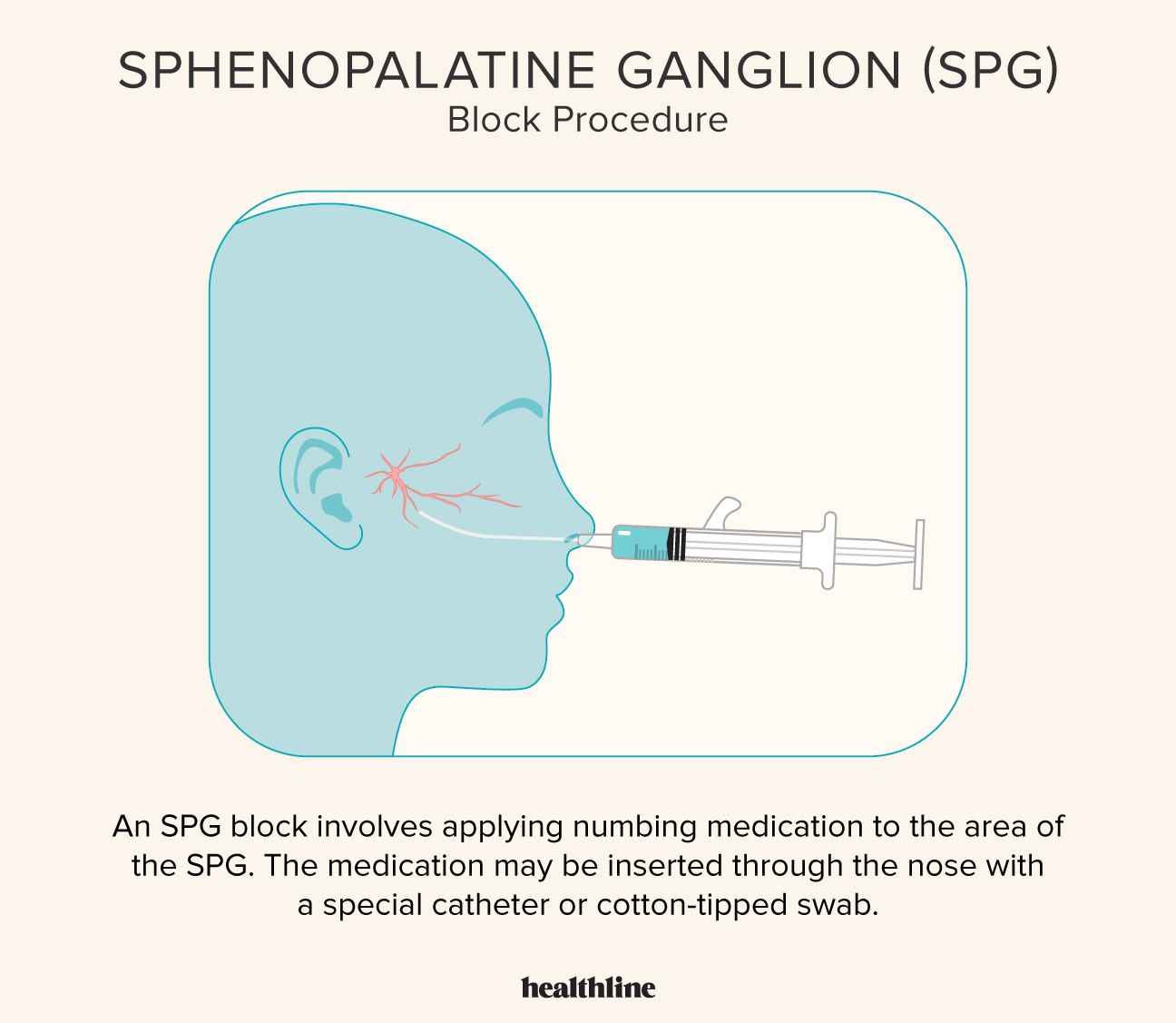
A doctor may use any of three standard methods to perform an SPG block:
- Transnasal approach: through the nose
- Transoral approach: through the mouth
- Infrazygomatic approach: beneath the zygomatic bone (cheekbone)
Transnasal approach
The transnasal approach has been around the longest. It involves inserting a cotton-tipped swab or specialized catheter into your nose. The instrument travels down your nasal floor, which is above the roof of your mouth, until it reaches your SPG.
According to a 2019 review, the transnasal approach is the simplest and fastest procedure.
Transoral approach
The transoral approach uses a dental needle to reach your SPG through your greater palatine foramen. This is a small opening in the roof of your mouth toward the back.
A 2019 review found the transoral approach to be less comfortable, more technically challenging, and more invasive than the transnasal approach. However, it provides
Infrazygomatic approach
The infrazygomatic approach is the most specialized. Using this method, a doctor reaches the SPG by inserting a needle below your cheekbone. This involves using a specialized type of X-ray called a fluoroscope.
This approach is the most invasive. Using a fluoroscope means exposing you to some radiation. The advantage is that it provides the
Can you apply an SPG block for migraine at home?
You may be able to perform a version of the transnasal SPG block on your own at home. Rather than using a catheter, as a doctor would, it may involve a syringe or a cotton-tipped applicator.
However, it’s important to have a healthcare professional show you how to administer the SPG block first.
The research on SPG blocks generally agrees that they’re an effective treatment for migraine headache pain. But experts also point out that most studies to date have small sample sizes and would benefit from additional trials.
For example, a 2021 review found a lack of studies that directly compare the effectiveness of various SPG block medications against each other. Existing studies haven’t determined whether any one medication produces the best results.
Most research agrees that SPG blocks can relieve pain during a migraine attack. People usually begin to experience some relief within 2 to 3 minutes, with the full effect of the treatment generally occurring within 15 minutes.
In a small 2020 study with 12 adults with migraine, researchers found that regular SPG block treatments can lead to structural changes in the brain. Participants reported less severe headaches and fewer headaches per month. This suggests that SPG blocks may work as a preventive treatment for migraine headaches, but more research is still needed.
SPG blocks may be an effective treatment for children with migraine as well. A 2021 study found SPG blocks reduced pain in children without immediate complications.
The medication in an SPG block can cause some side effects, but they’re generally mild. These may include:
- numbness
- tearing in one or both eyes
- bitter taste
The procedure itself can cause local effects in some cases, such as nosebleeds.
Getting an SPG block could result in infection or hematoma (bleeding), but these risks
The cost of an SPG block can vary from one practice to another. You can expect them to be over $100 and sometimes upward of $500. The cost may vary depending on which SPG block procedure you’re receiving.
Some insurance companies cover SPG blocks for migraine, but not all companies and not all policies do.
If you have insurance and want to find out whether your policy covers SPG blocks for migraine, contact your insurance company before scheduling your procedure.
The doctor’s office may also be experienced in billing SPG blocks and could help you determine what your policy covers and what your cost will be.
SPG blocks may be an option for treating migraine headaches that don’t improve with standard treatment.
For example, a
However, scientists have yet to establish the lasting effect of this treatment. While most studies agree that SPG blocks are effective for treating migraine pain, more research is needed to determine whether they can also prevent migraine attacks.
In addition to migraine, healthcare professionals have used SPG blocks to treat other conditions related to headache and facial pain, such as:
Just like with SPG block for migraine, more research is needed to better understand when and how doctors should use this treatment for these conditions.
People have also used SPG block as a pain management technique for various
SPG blocks are a typically safe and effective treatment for migraine pain. They may have preventive potential, too.
If you get an SPG block, a doctor will apply medication to your SPG, most commonly entering the nose with a catheter or cotton-tipped applicator. Pain relief generally happens within 15 minutes.
If you think an SPG block might be an effective migraine treatment for you, make an appointment with a doctor. They may even be able to teach you how to administer an SPG block at home.