Key takeaways
- Ubrelvy (ubrogepant) is a prescription medication used to treat migraine symptoms as they occur in adults. Ubrelvy comes as an oral tablet.
- Common side effects of Ubrelvy include sleepiness, nausea, and dry mouth. Serious side effects include new or worsening high blood pressure and Raynaud phenomenon.
- Ubrelvy works by blocking a protein called CGRP, which is involved in triggering migraine symptoms.
Ubrelvy is used to immediately treat migraine symptoms in adults. It’s not prescribed to help prevent migraine symptoms. To learn more about Ubrelvy’s uses, see the “Ubrelvy for migraine” section.
Ubrelvy basics
Ubrelvy is a brand-name medication. It contains the active ingredient ubrogepant. (An active ingredient is what makes a drug work.) A generic version of the drug isn’t currently available.
Ubrelvy belongs to a group of drugs called calcitonin gene-related peptide antagonists.
Whether you have health insurance or not, cost may be a factor when you’re considering Ubrelvy. What you’ll pay for Ubrelvy may depend on several things, such as your treatment plan and the pharmacy you use.
Here are a few things to consider regarding the cost of Ubrelvy:
- Comparing pharmacies: The price of Ubrelvy may vary depending on which pharmacy you use, so it can help to compare prices across pharmacies to find the lowest cost.
- Savings program: If you have questions about how to pay for your prescription, talk with your doctor or pharmacist. The Ubrelvy Complete Savings Card may be available to you.
Your doctor will recommend the dosage of Ubrelvy that’s right for you. The following text describes commonly used dosages, but always follow the dosage instructions that your doctor provides.
Form and strengths
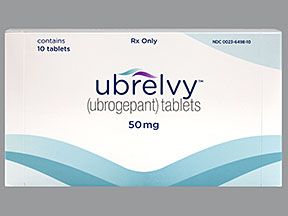
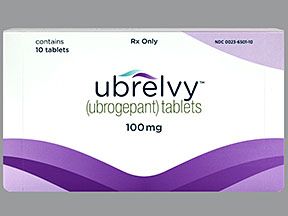
Ubrelvy comes as a tablet you swallow. It’s available in the following strengths:
- 50 milligrams (mg)
- 100 mg
Recommended dosage
You’ll take 50 mg or 100 mg of Ubrelvy when you need immediate treatment for a migraine episode. Then, you can take a second dose 2 hours after your first dose if needed.
You should not take more than 200 mg of the drug within 24 hours. This is the maximum dosage of the drug.
Also, you should not take Ubrelvy for more than eight migraine episodes in 30 days. The safety of taking Ubrelvy more often than this isn’t known. So talk with your doctor about how often you should take this drug.
How to take Ubrelvy
Your doctor will explain how you should take Ubrelvy, how much to take, and how often to take it. Be sure to follow your doctor’s instructions.
Ubrelvy comes as tablets that you swallow. You should take the medication as soon as you feel a migraine episode starting.
It’s important to note that you should avoid taking a second dose of Ubrelvy if you’ve consumed any grapefruit or grapefruit juice within 24 hours of your first dose. Doing so may increase the side effects of Ubrelvy. This is because grapefruit makes the drug stay in your body for longer than usual and can increase its side effects.
About taking Ubrelvy
Here are some answers to a few common questions related to taking Ubrelvy:
- Will I need to take Ubrelvy long term? If Ubrelvy works well for you, your doctor may recommend that you take it long term as needed for migraine episodes. You should discuss your migraine treatment plan with your doctor.
- How long does Ubrelvy take to work? Ubrelvy starts to work quickly. Most people get relief from migraine symptoms within 2 hours of taking a dose. And the effects of Ubrelvy may last for up to a day or longer.
- Can Ubrelvy be chewed, crushed, or split? No, you shouldn’t crush, chew, or split Ubrelvy tablets. It’s not known whether doing these things will change how the medication works. If you have difficulty swallowing pills, talk with your doctor about other treatment options.
- Should I take Ubrelvy with food? You can take Ubrelvy with or without food. But keep in mind that both Ubrelvy and migraine may cause nausea. So you’ll have to find out how well your body tolerates Ubrelvy either with food or on an empty stomach.
Overdose
Do not take more Ubrelvy than your doctor prescribes. Doing so can lead to serious side effects.
Call your doctor if you think you’ve taken too much Ubrelvy. You can also call 800-222-1222 to reach America’s Poison Centers, or you can use its online resource. But if you have severe symptoms, immediately call 911 or your local emergency number. Or go to the nearest emergency room.
Ubrelvy is used for immediate treatment of migraine symptoms in adults. It isn’t used to help prevent migraine symptoms.
With migraine, you can have symptoms such as:
- severe headaches
- nausea
- vomiting
- visual or sensory changes called an aura
Periods when symptoms occur are referred to as migraine episodes or migraine attacks. Ubrelvy can treat migraine episodes that happen with or without an aura.
Optum Perks is owned by RVO Health. By clicking on this link, we may receive a commission. Learn more.
Here are answers to some commonly asked questions about Ubrelvy.
What’s Ubrelvy’s mechanism of action? What’s its half-life?
Ubrelvy belongs to a group of drugs called CGRP antagonists. The mechanism of action for these drugs is to block the effects of a protein in your body called CGRP. (The mechanism of action describes how a drug works.)
Because CGRP is responsible for pain and inflammation tied to migraine, scientists theorize that medications such as Ubrelvy work by blocking CGRP. Levels of CGRP are increased during migraine episodes. And Ubrelvy helps bring these levels down.
Ubrelvy has a half-life of 5 to 7 hours. This means your body will get rid of half of a dose of the drug 5 to 7 hours after you take your dose. It takes about five half-lives for your body to fully clear a drug.
If you have more questions about how Ubrelvy works, talk with your doctor.
Is Ubrelvy a triptan?
No, Ubrelvy doesn’t belong to the group of drugs called triptans. Instead, it’s a CGRP antagonist.
Some other drugs used to manage migraine are triptans. These drugs include rizatriptan (Maxalt, Maxalt-MLT) and sumatriptan (Imitrex).
If you’d like information about taking a triptan for migraine treatment, talk with your doctor.
Is Ubrelvy a controlled substance?
No, Ubrelvy isn’t a controlled substance. Controlled substances have the potential to be misused. (With misuse, a drug is taken in a way other than how it’s prescribed.) But Ubrelvy doesn’t carry a risk of misuse.
Lasmiditan (Reyvow) is an example of a migraine drug that’s a controlled substance.
Talk with your doctor or pharmacist if you have questions about controlled substances.
Does Ubrelvy cause weight loss?
No, weight loss wasn’t seen in people during Ubrelvy’s studies. Another drug used for migraine, topiramate (Topamax, Trokendi XR), may cause weight loss. But Ubrelvy isn’t known to do this.
Keep in mind that migraine episodes can cause nausea and vomiting. In some cases, these symptoms could lead to weight loss.
If you’re having weight loss with Ubrelvy, talk with your doctor. They can recommend ways to help you manage a weight that’s healthy for you.
Is Ubrelvy used for tension headaches?
No, Ubrelvy is not approved for treating tension headaches. (These headaches cause pain that may feel like a tight band around your forehead.) Ubrelvy is approved to treat migraine headaches.
If you’d like to learn about treatment options for tension headaches, talk with your doctor.
Like most drugs, Ubrelvy may cause mild or serious side effects. The following lists describe some of the more common side effects of Ubrelvy. These lists don’t include all possible side effects.
The side effects of a drug can vary from person to person. And they may depend on:
- your age
- your overall health
- other medications you may be taking
- the dosage of medication you’re taking
- other factors
Your doctor or pharmacist can tell you more about the possible side effects of Ubrelvy. They can also suggest ways to help reduce the drug’s side effects.
Mild side effects
Here’s a list of some of the mild side effects that Ubrelvy can cause. To learn about other mild side effects, talk with your doctor or pharmacist or read Ubrelvy’s prescribing information.
Mild side effects of Ubrelvy can include:
Mild side effects of many drugs may go away within a few days or a couple of weeks. But if they become bothersome, talk with your doctor or pharmacist.
Serious side effects
Serious side effects from Ubrelvy can occur, but they aren’t common. If you have serious side effects from Ubrevly, call your doctor right away. If you think you’re having a medical emergency, you should call 911 or your local emergency number.
Serious side effects of Ubrelvy that have been reported include:
- high blood pressure
- Raynaud phenomenon (reduced blood flow in the extremities)
Allergic reactionSome people may have an allergic reaction to Ubrelvy.
Symptoms of a mild allergic reaction can include:
- skin rash
- itchiness
- flushing (temporary warmth, redness, or deepening of skin color)
A more severe allergic reaction called anaphylaxis is rare but possible. Symptoms of a severe allergic reaction can include:
- swelling under your skin, typically in your eyelids, lips, hands, or feet
- swelling of your tongue, mouth, or throat, which can cause difficulty breathing
- hives and itchy skin
Call your doctor right away if you have an allergic reaction to Ubrelvy. But if you think you’re having a medical emergency, call 911 or your local emergency number.
Ubrelvy is used to manage migraine in adults. Specifically, it’s used for immediate treatment of migraine symptoms. It’s not used to prevent migraine symptoms.
Other drugs are used to treat migraine symptoms. Examples include:
- rimegepant (Nurtec ODT)
- eletriptan (Relpax)
- lasmiditan (Reyvow)
- triptans, such as sumatriptan (Imitrex) and rizatriptan (Maxalt, Maxalt-MLT)
Some examples of medications that prevent migraine symptoms include:
- erenumab (Aimovig)
- galcanezumab (Emgality)
- topiramate (Topamax, Trokendi XR)
To learn more about alternatives to Ubrelvy, talk with your doctor.
What to know about Ubrelvy vs. Nurtec
Ubrelvy and Nurtec ODT are both used to treat migraine episodes in adults. Ubrelvy comes as an oral tablet, while Nurtec is available as an orally disintegrating tablet (ODT). To learn more, see this Ubrelvy vs. Nurtect ODT comparison article.
What to know about Ubrelvy vs. Imitrex
Ubrelvy and Imitrex are both used to treat migraine episodes in adults. Ubrelvy comes as an oral tablet, while Imitrex is available in several forms: an oral tablet, a subcutaneous injection, and a nasal spray. To learn more, see this Ubrelvy vs. Imitrex comparison article.
Using certain medications, vitamins, or foods alongside certain drugs can affect how they all work. These effects are called interactions.
Interactions can change a drug’s effect in your body, which can lead to two possible outcomes:
- The drug’s effect is lowered so that it doesn’t work as well as usual.
- The drug’s effect is raised so that it lasts for longer in your body and may cause increased side effects.
Before taking Ubrelvy, be sure to tell your doctor about all medications you take, including prescription and over-the-counter types. Also, describe any vitamins, herbs, or supplements you use. Your doctor or pharmacist can tell you about any interactions Ubrelvy may cause with these items.
Interactions with drugs or supplements
Ubrelvy can interact with certain drugs that increase effects of Ubrelvy in your body. These drugs include:
- certain HIV medications, such as cobicistat (Tybost), ritonavir (Norvir), and nelfinavir mesylate (Viracept)
- certain antibiotics, including ciprofloxacin (Cipro)
- antifungals, such as fluconazole (Diflucan)
- verapamil (Verelan), a blood pressure drug
- cyclosporine (Neoral), an immunosuppressant drug
- fluvoxamine (Luvox), an antidepressant
Ubrelvy can also interact with certain medications in a way that leads to lower effects of Ubrelvy in your body. These drugs include:
- rifampin (Rifadin), an antibiotic
- seizure medications, such as phenytoin (Dilantin) and carbamazepine (Tegretol)
- barbiturates
These lists do not contain all types of drugs that may interact with Ubrelvy. Your doctor or pharmacist can tell you more about these interactions and any others that may occur with Ubrelvy.
Note: Taking certain medications with Ubrelvy is contraindicated. (A contraindication is a factor or condition that could prevent your doctor from prescribing a drug due to a risk of harm.) Ask your doctor for more information about medications that are contraindicated with Ubrelvy.
Other interactions
In addition to the medications described previously, Ubrelvy can also interact with other substances. For example:
- Grapefruit or grapefruit juice may increase side effects of Ubrelvy by increasing the drug’s effect in your body.
- St. John’s wort can lower the effect of Ubrelvy in your body.
There isn’t enough information available about the effects of taking Ubrelvy during pregnancy or while breastfeeding in humans. But in animal studies, Ubrelvy has been shown to cause fetal harm during pregnancy and low birth weight in lactating animals. If you’re pregnant or breastfeeding, or planning to become pregnant or to breastfeed, talk with your doctor about the safety of taking Ubrelvy.
Ubrelvy may not be right for you if you have certain medical conditions or other factors that affect your health. Talk with your doctor about your health history before you take Ubrelvy. Some factors to consider include those in the following list:
- kidney problems
- liver problems
- high blood pressure
- Raynaud phenomenon
- allergic reaction
- pregnancy
- breastfeeding
Q:
Can I take Ubrelvy with acetaminophen (Tylenol) or ibuprofen (Motrin)?
AnonymousA:
There aren’t any known interactions between Ubrelvy and acetaminophen (Tylenol) or ibuprofen (Motrin). But you should only take Ubrelvy with an additional pain medication like these if your doctor recommends it. Keep in mind that Ubrelvy is approved to treat a migraine episode on its own without other drugs.
The Healthline Pharmacist TeamAnswers represent the opinions of our medical experts. All content is strictly informational and should not be considered medical advice.Disclaimer: Healthline has made every effort to make certain that all information is factually correct, comprehensive, and up to date. However, this article should not be used as a substitute for the knowledge and expertise of a licensed healthcare professional. You should always consult your doctor or another healthcare professional before taking any medication. The drug information contained herein is subject to change and is not intended to cover all possible uses, directions, precautions, warnings, drug interactions, allergic reactions, or adverse effects. The absence of warnings or other information for a given drug does not indicate that the drug or drug combination is safe, effective, or appropriate for all patients or all specific uses.