Key takeaways
- Tepezza is an intravenous medication that may help treat thyroid eye disease (TED) by addressing immune system activity behind the eyes.
- Possible side effects of Tepezza include hearing issues, infusion reactions, and muscle spasms, which usually can be successfully managed.
- Tepezza infusions are given every 3 weeks for about 5 months. Tepezza is usually safe with other medications, but it is not recommended if you are pregnant.
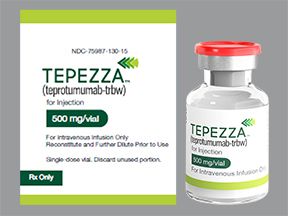
Tepezza (teprotumumab-trbw) is a medication prescribed to treat thyroid eye disease (TED). It comes as a powder that’s mixed with sterile water to make a liquid solution that is given by intravenous (IV) infusion.
Tepezza contains the active ingredient teprotumumab-trbw. (An active ingredient is what makes a medication work.)
Teprotumumab is a biologic medication. Biologic drugs (or “biologics”) are made from parts of living organisms. Specifically, teprotumumab is a human monoclonal antibody that belongs to a group of drugs called insulin-like growth factor-1 receptor (IGF-1R) inhibitors. (IGF-1R is a protein found on the surface of human cells that plays a role in regulating the growth, development, and proliferation of cells in our body.)
Currently, teprotumumab is only available as the brand-name drug Tepezza. But biosimilar versions of the drug might be developed in the future.
Biosimilar drugs have the same active ingredient core name as the brand-name drug they are designed to mimic. But they have unique suffixes. This is why “-trbw” appears at the end of the name of the active ingredient in Tepezza — it’s to show that the teprotumumab in Tepezza is distinct from what’s found in biosimilar versions of Tepezza that may be created in the future.
Specifically, Tepezza is used to treat thyroid eye disease (TED) in adults only. The safety and effectiveness of Tepezza have not been established for use in children.
TED is an autoimmune disease. This means it’s caused by your immune system mistakenly attacking healthy tissues in your body. TED is also called Graves’ eye disease or Graves’ ophthalmopathy.
With TED, your immune system attacks the muscle and fat tissue behind your eyes. This causes inflammation (swelling) in these tissues.
Symptoms of TED may include:
- bulging eyes
- eye pain, including pain behind your eyes or when moving your eyes
- redness and swelling of your eyes and eyelids
- double vision
In rare cases, the swelling can press on your optic nerve, causing vision loss.
Tepezza helps reduce these symptoms of TED.
Thyroid eye disease most commonly develops in people who have another autoimmune disease called Graves’ disease. With this condition, your immune system attacks your thyroid gland, causing hyperthyroidism (overactive thyroid). It can also attack the tissue behind your eyes, causing TED. But TED can also develop in people who don’t have Graves’ disease.
Note: Tepezza is not approved to treat Graves’ disease.
Your doctor will recommend the dosage of Tepezza that’s right for you. Below are commonly used dosages, but the dosage you receive will be determined by your doctor.
Form
Tepezza comes as a powder inside single-dose vials. Your doctor will use the powder to make a liquid solution of Tepezza. You’ll be given the Tepezza solution by intravenous (IV) infusion. With an IV infusion, the drug is injected into a vein (usually in your arm) over a period of time.
Recommended dosage
To treat thyroid eye disease (TED), you’ll usually receive a Tepezza infusion every 3 weeks. You’ll receive eight infusions in total over the course of about 5 months.
For your first infusion, the recommended dose of Tepezza is 10 milligrams per kilogram of body weight (mg/kg). For the next seven infusions, the recommended dose is 20 mg/kg.
For example, if you weigh 60 kg (about 132 pounds), for your first infusion you’ll receive a dose of 600 mg. For your next seven infusions you’ll receive a dose of 1,200 mg.
Like most drugs, Tepezza may cause mild or serious side effects. The most common side effects of Tepezza reported in clinical studies of the drug include:
- muscle spasms
- nausea
- diarrhea
- fatigue
- hair loss
- high blood sugar (hyperglycemia)
- hearing loss
- change in the way things taste
- headache
- dry skin
Whether you have health insurance or not, cost may be a factor when you’re considering Tepezza. What you’ll pay for Tepezza may depend on several things, such as your treatment plan and the pharmacy your doctor uses.
If you have questions about how to pay for your prescription, talk with your doctor. A program called Amgen By Your Side may also be available. (Amgen is the manufacturer of Tepezza.)
Note: Tepezza is a specialty medicine that is not available at your local pharmacy. Specialty medicines like Tepezza often require prior approval from your insurance company before you begin treatment. Ask your doctor for details.
Here are answers to some commonly asked questions about Tepezza.
Can I see photos of people before and after Tepezza?
Yes, you can. You can find pictures of people with TED who’ve used Tepezza on the manufacturer’s website.
Keep in mind that your results with Tepezza may differ. Talk with your doctor to find out more about what you can expect from your treatment.
How does Tepezza work? What is the drug’s mechanism of action?
Tepezza is used to treat thyroid eye disease (TED). This condition occurs when your immune system mistakenly attacks the muscle and fat tissue behind your eyes.
Tepezza’s mechanism of action (how it works) for treating TED isn’t fully understood. The drug attaches to certain proteins found on the surface of your cells. By doing this, Tepezza keeps your immune system from activating the proteins. This helps protect the muscle and fat tissue behind your eyes from your immune system.
Is it safe to use eye drops during Tepezza treatment?
Yes, it’s usually safe to use eye drops during your Tepezza treatment. In fact, your doctor may recommend using certain eye drops to help reduce your symptoms until Tepezza starts working.
For example, your doctor may recommend lubricant eye drops if your eyes are dry, itchy, gritty, or irritated. And they may prescribe steroid eye drops to help reduce eye inflammation (swelling).
Eye drops aren’t known to interact with Tepezza. But be sure to talk with your doctor about any medications that you use during your Tepezza treatment. They can make sure the drugs are safe to use with Tepezza.
Should I change my diet during my Tepezza treatment?
In some cases, you may need to make changes to your diet while receiving Tepezza infusions.
For example, you may need to adjust your diet if you have diabetes or prediabetes. Tepezza may cause high blood sugar, and your risk of this side effect is higher if you have one of these conditions.
For more about possible changes to your diet during your Tepezza treatment, talk with your doctor.
Before taking Tepezza, it’s important to consider your overall health, any medical conditions you have, and any medications you take. Talk with your doctor about how Tepezza could affect you.
Interactions
Taking a medication with certain drugs, foods, and other things can affect how the medication works. These effects are called interactions.
There are no known interactions between Tepezza and other drugs or supplements. But before taking Tepezza, be sure to tell your doctor about all medications you take, including prescription and over-the-counter types. Also describe any vitamins, herbs, or supplements you use. Your doctor or pharmacist can tell you about any interactions these items may cause with Tepezza.
Warnings
Tepezza may not be right for you if you have certain medical conditions or other factors that affect your health. Talk with your doctor about your health history before you take Tepezza. Factors to consider include those in the list below.
- Hearing problems: Tepezza may cause serious hearing problems, including hearing loss. In some people these changes may not go away after treatment ends. Tell your doctor right away if you notice any changes in your hearing. They may check your hearing and decide if it’s safe to continue Tepezza treatment.
- Diabetes or prediabetes: Tepezza may raise your blood sugar levels. Your risk for this side effect is higher if you have diabetes or prediabetes. If you have one of these conditions, your doctor will make sure your blood sugar is well managed before you start treatment with Tepezza. They’ll also monitor your blood sugar level more closely during your treatment. If needed, they may adjust your diabetes treatment plan to help manage your blood sugar.
- Inflammatory bowel disease: If you have inflammatory bowel disease, such as ulcerative colitis or Crohn’s disease, Tepezza could make your symptoms worse. Also, some people receiving Tepezza infusions reported IBD symptoms without having a prior diagnosis of the disease. Tell your doctor if you have new or worsening diarrhea, rectal bleeding, abdominal pain, or other symptoms. Your doctor may decide to stop your Tepezza treatment if IBD or worsening of IBD is suspected.
- Allergic reaction: If you’ve had an allergic reaction to Tepezza or any of its ingredients, your doctor will likely not prescribe Tepezza. Ask your doctor what other medications are better options for you.
Tepezza and alcohol
Tepezza isn’t known to interact with alcohol. But drinking alcohol may worsen certain side effects of Tepezza, such as nausea, headache, or diarrhea.
If you drink alcohol, talk with your doctor about whether it’s safe to drink during your Tepezza treatment.
Pregnancy and breastfeeding
It’s not safe to receive Tepezza during pregnancy. This medication could harm a fetus. If you’re pregnant or planning to become pregnant, talk with your doctor about other treatment options.
If you’re receiving Tepezza and can become pregnant, you should use birth control before and during your treatment. And you’ll need to keep using birth control for at least 6 months after your last dose of Tepezza. Before starting treatment with Tepezza, talk with your doctor about your birth control needs.
It’s not known if it’s safe to receive Tepezza infusions while breastfeeding. If you’re currently breastfeeding or planning to breastfeed, talk with your doctor before starting treatment.
Disclaimer: Healthline has made every effort to make certain that all information is factually correct, comprehensive, and up to date. However, this article should not be used as a substitute for the knowledge and expertise of a licensed healthcare professional. You should always consult your doctor or another healthcare professional before taking any medication. The drug information contained herein is subject to change and is not intended to cover all possible uses, directions, precautions, warnings, drug interactions, allergic reactions, or adverse effects. The absence of warnings or other information for a given drug does not indicate that the drug or drug combination is safe, effective, or appropriate for all patients or all specific uses.