Key takeaways
- Stelara is a biologic medication prescribed for autoimmune conditions such as plaque psoriasis and Crohn’s disease.
- Common side effects of Stelara include upper respiratory infections and headaches.
- The dosage of Stelara that your doctor prescribes will be based on your age, weight, and the condition it’s treating.
Stelara is used to treat:
- plaque psoriasis in adults and some children
- psoriatic arthritis in adults and some children
- Crohn’s disease in adults
- ulcerative colitis in adults
To learn more about these conditions and how Stelara is used for them, see the “What is Stelara used for?” section.
Stelara basics
Stelara contains the drug ustekinumab, which is a biologic medication. A biologic medication is made from living cells.
Ustekinumab also comes in biosimilar forms, including Selarsdi (ustekinumab-aekn), Wezlana (ustekinumab-auub), Steqeyma (ustekinumab-stba), and others. Biosimilars are like generic drugs. But unlike generics, which are made for nonbiologic drugs, biosimilars are made for biologic drugs.
Like most drugs, Stelara may cause mild or serious side effects. Here, you’ll find information on some of the more common side effects Stelara may cause. Not all possible side effects are listed.
Your doctor or pharmacist can tell you more about the potential side effects of Stelara. They can also suggest ways to help reduce side effects.
Mild side effects
Here’s a short list of some of the mild side effects that Stelara can cause. Keep in mind that side effects of Stelara might differ slightly depending on the condition for which you’re using the drug.
To learn about other mild side effects, talk with your doctor or pharmacist or read Stelara’s prescribing information.
Mild side effects of Stelara can include:
- upper respiratory infections, such as the common cold
- headache
- fatigue (low energy)
- abdominal pain
- nausea
- vomiting
- diarrhea
- itchiness
- skin discoloration at the drug injection site
- vaginal yeast infection
- urinary tract infection (UTI)
For more information about colds, see the “Side effect focus” section.
Mild side effects of many drugs may go away within a few days to a couple of weeks. But if they become bothersome, talk with your doctor or pharmacist.
Serious side effects
Serious side effects from Stelara can occur, but they are not common. If you have serious side effects from this drug, call your doctor right away. However, if you think you’re having a medical emergency, you should call 911 or your local emergency number.
Serious side effects can include:
- posterior reversible encephalopathy syndrome (PRES), which is a condition that causes swelling in your brain and may lead to headache
- cancer
- allergic reaction
- serious infections such as pneumonia
For more information about some of these side effects, see the “Side effect focus” section next.
Side effect focus
Learn more about some of the side effects Stelara may cause.
Colds
You’re more likely than usual to get a cold when you’re using Stelara. This drug slows down the activity of your immune system, reducing your body’s ability to fight off infections. With lowered immunity, you have a higher risk of catching a cold.
The common cold is an infection caused by viruses. With a cold, you may have symptoms such as:
- cough
- sore throat
- runny nose
- pain in your sinuses (area around your nose and eyes)
- blocked sinuses
- headache
- mild fever
- sneezing
- muscle aches
What might help
If you’re getting colds while you’re receiving Stelara, talk with your doctor about ways to help prevent them.
Viruses that cause the common cold are spread between people through the air and on surfaces. To help reduce your risk of catching a cold, try the following tips:
- Wash your hands frequently with soap and water.
- Avoid touching your face with unwashed hands.
- Avoid contact with, or maintain physical distance from, people who are sick.
You may also want to use over-the-counter (OTC) medications to treat your cold symptoms. But be sure to check with your doctor or pharmacist before using any medications with Stelara. And keep in mind that some OTC medications may help relieve cold symptoms, but the medications will not cure your cold.
You can also talk with your doctor or pharmacist about other remedies for your cold symptoms.
Headaches
You may have headaches while you’re receiving Stelara. This is one of the more common side effects of the drug.
While using Stelara, you may also have headaches from a condition called posterior reversible encephalopathy syndrome (PRES). PRES is a rare but serious condition that’s due to swelling in the brain. Studies of Stelara reported this as a side effect of the drug.
Other symptoms you may have with PRES include:
- seizures
- confusion
- changes in your vision
It’s possible to develop symptoms of PRES after a few days to a few months of starting Stelara.
What might help
If you have headaches when using Stelara, talk with your doctor. But seek emergency medical attention if you have a headache along with other symptoms of PRES.
If you have PRES, your doctor will recommend that you stop receiving Stelara. But do not stop receiving Stelara without talking with your doctor.
Keep in mind that having headaches while using Stelara does not always mean you have PRES. Several OTC drugs can help relieve the discomfort of a headache. Check with your doctor or pharmacist about which options are safe for you.
Cancer
Stelara lowers the activity of your immune system, and this may increase your risk of certain cancers. In studies, some people receiving Stelara were more likely to get skin cancer.
Before starting Stelara, tell your doctor if you’ve ever had cancer. This drug was not studied for safety in people with a history of cancer.
What might help
While you’re receiving Stelara, your doctor will monitor you for any signs of skin cancer.
You may have a higher risk of cancer and need closer monitoring during treatment if you:
- are age 60 years or older
- have taken drugs that work on your immune system over a long period of time
- had photochemotherapy treatment in the past
While receiving Stelara, check your skin regularly for any changes. Be sure to tell your doctor if you notice any new growths or other changes. You can also ask your doctor to show you how to do your own skin exam.
Allergic reactionSome people may have an allergic reaction to Stelara. In addition, if you’re allergic to latex, you should not handle the needle cover of Stelara’s prefilled syringe. It contains latex and may cause an allergic reaction if you’re sensitive to latex.
Symptoms of a mild allergic reaction can include:
- rash
- itchiness
- flushing (temporary warmth, discoloration, or deepening of skin color)
A more severe allergic reaction is rare but possible. Severe allergic reactions were reported during studies of Stelara. If you have a severe allergic reaction, you must seek medical help right away and stop using Stelara.
Symptoms of a severe allergic reaction can include swelling under your skin, typically in your eyelids, lips, hands, or feet. They can also include swelling of your tongue, mouth, or throat, which can cause difficulty breathing.
Call your doctor right away if you have an allergic reaction to Stelara. But if you think you’re having a medical emergency, call 911 or your local emergency number.
Here you’ll find information on commonly used dosages, but always follow the dosage your doctor prescribes. They’ll recommend the dosage of Stelara that’s right for you.
Forms and strengths
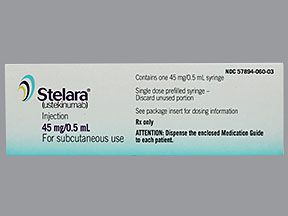
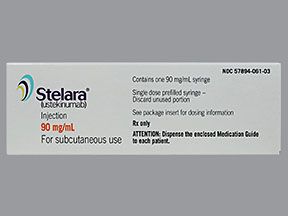
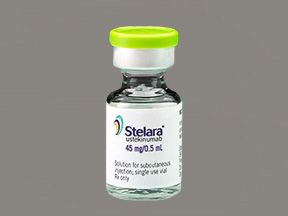
Stelara comes as a liquid solution inside prefilled syringes and single-dose vials for injection under your skin.
Stelara liquid solution for injection under your skin is available in two strengths:
- 90 milligrams per milliliter (mg/mL), in single-dose prefilled syringes
- 45 mg/0.5 mL, in single-dose prefilled syringes and single-dose vials
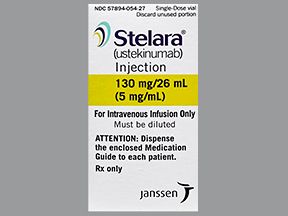
Stelara also comes as a solution inside single-dose vials that you’ll receive from healthcare professionals as an intravenous (IV) infusion. With an IV infusion, you’ll get the medication through your vein over a period of time.
Stelara liquid solution for IV infusion is available in single-dose vials in one strength: 130 mg/26 mL.
Recommended dosages
Your doctor will recommend the dosage of Stelara that’s right for you. Here you’ll find commonly used dosages, but the dosage you receive will be determined by your doctor.
Dosage for plaque psoriasis
If you’re an adult with plaque psoriasis, your dosage will be based on your weight as follows. Body weight is given in kilograms (kg), with 1 kg equal to about 2.2 pounds (lb). Doses are given in milligrams (mg). You’ll receive all doses as an injection under your skin.
| Body weight | Initial injection dosage | Subsequent injection dosage |
|---|---|---|
| 100 kg (about 220 lb) or less | 45 mg, followed by 45 mg after 4 weeks | 45 mg every 12 weeks |
| More than 100 kg | 90 mg, followed by 90 mg after 4 weeks | 90 mg every 12 weeks |
Doctors will likely recommend one of the following dosage schedules, based on body weight, for children ages 6 and older with plaque psoriasis. All doses are given as an injection under the skin.
| Children’s body weight | Initial injection dosage | Subsequent injection dosage |
|---|---|---|
| less than 60 kg (about 132 lb) | 0.75 mg per kg of body weight (mg/kg), followed by 0.75 mg/kg after 4 weeks | 0.75 mg/kg every 12 weeks |
| 60 kg to 100 kg | 45 mg, followed by 45 mg after 4 weeks | 45 mg every 12 weeks |
| More than 100 kg | 90 mg, followed by 90 mg after 4 weeks | 90 mg every 12 weeks |
Dosage for psoriatic arthritis
If you’re an adult with psoriatic arthritis, your dosage will depend on whether your body weight is more than 100 kg and you also have plaque psoriasis. You’ll receive all doses as an injection under your skin.
| Body weight, without or with plaque psoriasis | Initial injection dosage | Subsequent injection dosage |
|---|---|---|
| • any body weight without plaque psoriasis, or • less than 100 kg with plaque psoriasis | 45 mg, followed by 45 mg after 4 weeks | 45 mg every 12 weeks |
| 100 kg or more with plaque psoriasis | 90 mg, followed by 90 mg after 4 weeks | 90 mg every 12 weeks |
Doctors will likely recommend one of the following dosage schedules, based on body weight, for children ages 6 and older with psoriatic arthritis. Which dosage schedule is prescribed may also depend on whether a child’s body weight is more than 100 kg and if they also have plaque psoriasis. All doses are given as an injection under the skin.
| Children’s body weight, without or with plaque psoriasis | Initial injection dosage | Subsequent injection dosage |
|---|---|---|
| less than 60 kg | 0.75 mg per kg of body weight (mg/kg), followed by 0.75 mg/kg after 4 weeks | 0.75 mg/kg every 12 weeks |
| • 60 kg or more without plaque psoriasis, or • 60 kg to less than 100 kg with plaque psoriasis | 45 mg, followed by 45 mg after 4 weeks | 45 mg every 12 weeks |
| 100 kg or more with plaque psoriasis | 90 mg, followed by 90 mg after 4 weeks | 90 mg every 12 weeks |
Dosage for Crohn’s disease or ulcerative colitis
If you have Crohn’s disease or ulcerative colitis, your doctor will prescribe a loading dose of Stelara at the start of treatment. (A loading dose is a one-time dose that’s given to boost the level of a drug in your body.)
For a loading dose, you’ll receive the drug as an IV infusion that will last at least 1 hour. Your doctor will base this initial dose for IV infusion on your body weight, as shown in the following table.
| Body weight | Initial (loading) IV infusion dose |
|---|---|
| 55 kg (about 121 lb) or less | 260 mg |
| more than 55 kg to 85 kg (about 187 lb) | 390 mg |
| more than 85 kg | 520 mg |
After the IV infusion, your doctor will prescribe injections of Stelara. You’ll receive Stelara as a 90-mg injection under your skin 8 weeks after you had the loading dose. Then, you’ll keep getting these 90-mg injections once every 8 weeks.
Your doctor will explain how you should receive Stelara injections. They will also explain how much to inject and how often. Be sure to follow your doctor’s instructions. Here are commonly recommended dosages, but always follow the dosing schedule your doctor prescribes.
Receiving Stelara
Stelara comes as a solution inside prefilled syringes and single-dose vials. You’ll receive this solution as an injection under your skin.
Stelara also comes as a solution inside single-dose vials for intravenous (IV) infusion. With an IV infusion, a healthcare professional will administer the medication into your vein over a period of time.
If you are receiving Stelara for Crohn’s disease or ulcerative colitis, you will receive an IV infusion when you first start Stelara. This will be followed by injections under your skin.
Injection sites for Stelara
Your doctor or nurse will show you how to inject Stelara under your skin. Every time you inject Stelara, you should change the site where you’re injecting the drug. You can choose from the following locations:
- buttocks
- front of your thighs
- your abdomen, staying 2 inches (5 centimeters) away from your belly button
If a caregiver is giving you the drug, they may also inject the drug into the outer side of your upper arms.
Using Stelara with other drugs
You may need to use Stelara with other medications to treat your condition. Talk with your doctor if you have questions about using other drugs together with Stelara.
Other drugs with Stelara for psoriasis or psoriatic arthritis
It’s not known whether taking other immune system blockers or using phototherapy with Stelara for psoriasis is safe. But methotrexate (Trexall, Rasuvo) may be used with Stelara to treat psoriatic arthritis if appropriate. It’s not known to interfere with the safety and efficacy of Stelara.
Other drugs with Stelara for Crohn’s disease or ulcerative colitis
For Crohn’s disease or ulcerative colitis, the following medications may be used with Stelara if appropriate:
- 6-mercaptopurine
- azathioprine (Azasan, Imuran)
- methotrexate
These medications do not affect the safety and effectiveness of Stelara. Also, if needed, your doctor may recommend that you use corticosteroids together with Stelara.
Will I need to use Stelara long term?
The conditions that Stelara treats are long-lasting diseases. So you’ll likely receive Stelara long term if it’s working well for you. Talk with your doctor to find out how long you can stay on Stelara.
You should not stop receiving Stelara without first checking with your doctor. Stopping the drug may cause symptoms of your condition to come back. Once you stop Stelara treatment, your doctor will monitor you to make sure you can safely stay off the treatment.
Questions about receiving Stelara
Here we answer some common questions about receiving Stelara.
What if I miss a dose of Stelara? If you forget to inject a dose of Stelara, inject your dose as soon as you remember. If you’re unsure about when you should inject Stelara after missing a dose, talk with your doctor or pharmacist. They can help you set up a new schedule for your at-home injections.
Should I receive Stelara with food? Stelara is administered as either an injection under your skin or an intravenous (IV) infusion. Eating food does not affect how your body absorbs this drug.
How long does Stelara take to work? Everyone may have a different experience with Stelara treatment. And how long Stelara takes to work may depend on the condition it’s treating.
For plaque psoriasis, you may have a significant reduction in your symptoms after 12 weeks. For psoriatic arthritis, you may notice a significant reduction after 24 weeks of treatment. But it’s possible that your symptoms will ease earlier. Stelara may work more quickly when it’s used for Crohn’s disease or ulcerative colitis.
Questions for your doctorYou may have questions about Stelara and your treatment plan. It’s important to discuss all your concerns with your doctor.
Here are a few tips that might help guide your discussion:
- Before your appointment, write down questions like:
- How will Stelara affect my body, mood, or lifestyle?
- Bring someone with you to your appointment if doing so will help you feel more comfortable.
- If you do not understand something related to your condition or treatment, ask your doctor to explain it to you.
Remember, your doctor and other healthcare professionals are available to help you. And they want you to get the best care possible. So do not be afraid to ask questions or offer feedback on your treatment plan.
Whether you have health insurance or not, cost may be a factor when you’re considering Stelara. The cost of Stelara may depend on several things, such as your treatment plan and the pharmacy you use.
If you have questions about how to pay for your prescription, talk with your doctor or pharmacist. A program called STELARA withMe may also be available.
Here are a few more ways to help save on the cost of your prescription:
- Comparing pharmacies: The price of Stelara may vary depending on which pharmacy you use, so it can help to compare prices across pharmacies to find the lowest cost.
- Drug coupons: You may be able to find drug coupons on prescription discount websites that can reduce the cost of your medication. These coupons cannot be used with insurance copays or benefits, but the discounted price may be lower than what you would pay through insurance.
- Financial assistance: Some websites provide details about drug assistance programs, ways to make the most of your insurance coverage, and links to savings cards and other services. Two such websites are:
If you have certain autoimmune conditions, your doctor may prescribe Stelara for you. (With autoimmune diseases, your immune system is overactive.)
Stelara is used for the following long-lasting diseases:
- Moderate to severe plaque psoriasis (PsO): For PsO, adults and children ages 6 years and older can receive Stelara. With PsO, you have swollen, discolored patches on your skin. Over time, you may also develop swollen joints.
- Psoriatic arthritis (PsA): For PsA, adults and children ages 6 years and older can receive Stelara. With PsA, you have discolored patches of skin and swollen joints. You may have arthritis in joints on both or just one side of your body. Usually, you’ll develop skin issues before you develop joint swelling from PsA.
- Moderate to severe Crohn’s disease: Adults can receive Stelara for Crohn’s disease. This is a condition that affects the digestive system. With Crohn’s disease, you may have inflammation in any part of your digestive tract, from your mouth to your anus. You may have unpredictable periods of remission (times when your symptoms are managed) and you may have periods of relapse (times when your symptoms worsen).
- Moderate to severe ulcerative colitis (UC): For UC, adults can receive Stelara. With UC, you have inflammation in your large intestine. With UC, you may have unpredictable periods of remission and relapse.
To manage symptoms of these long-lasting diseases, your doctor may prescribe medications to slow down the activity of your immune system.
Stelara is an antibody (a type of protein) that’s made in a lab. It works by blocking substances made by your immune system that can cause long-lasting inflammation. These substances, called cytokines, promote inflammation and may cause disease. By blocking cytokines, Stelara can help manage symptoms and relapses of certain diseases.
Find answers to some commonly asked questions about Stelara.
How does Stelara compare with Humira?
Both Stelara and Humira are biologic medications, which means they’re made from living cells.
Humira is only given as an injection under the skin. But Stelara can be given as an injection under the skin or as an intravenous (IV) infusion. (With an IV infusion, you’ll get the medication through your vein over a period of time.)
Adults can receive either Stelara or Humira for:
Stelara can also be prescribed for children ages 6 years and older with plaque psoriasis or psoriatic arthritis. Humira is used for other conditions, too. These include rheumatoid arthritis in adults and juvenile idiopathic arthritis in some children.
Both Humira and Stelara target certain parts of your immune system. But each drug targets a different part:
- Humira blocks the action of a protein called tumor necrosis factor (TNF).
- Stelara blocks the action of proteins called interleukin-12 and interleukin-23.
The different ways these two drugs work may explain the differences in their side effects. For instance, unlike Stelara, Humira has a boxed warning for serious infections and cancer. (A boxed warning is the most serious warning given about a drug’s side effects.) Stelara may also cause serious infections and cancer. But it does not have a boxed warning for these conditions.
If you’d like to know more about the differences between these two drugs, talk with your doctor or pharmacist or see this Stelara vs. Humira comparison.
Does Stelara cause weight gain?
No, Stelara does not affect your weight.
However, if you’re using Stelara for Crohn’s disease, note that the condition itself may cause weight loss.
If you experience weight loss or weight gain while receiving Stelara, talk with your doctor. They can try to determine what’s causing your weight to change. And they can suggest ways to help you manage a body weight that’s healthy for you.
If I stop receiving Stelara, will I have withdrawal symptoms?
No, you will not have withdrawal symptoms if you stop receiving Stelara. Withdrawal symptoms are uncomfortable side effects that can occur when you stop receiving a drug your body is used to.
But keep in mind that the symptoms of your condition may come back if you stop treatment. Once you stop receiving Stelara, your doctor will monitor you to make sure you can safely stay off the treatment.
Be sure to talk with your doctor before stopping Stelara treatment.
Some important things to discuss with your doctor when considering Stelara include your general health and any medical conditions you may have. Other important things your doctor needs to know include whether you’re pregnant, breastfeeding, or considering pregnancy or breastfeeding.
Additionally, tell your doctor if you’re taking any prescription or over-the-counter (OTC) medications.
Interactions
Taking medications, vaccines, foods, and other things with a certain drug can affect how the drug works. These effects are called interactions.
Before starting Stelara, be sure to tell your doctor about all medications you take (including prescription and OTC types). Also, describe any vitamins, herbs, or supplements you use. Your doctor or pharmacist can tell you about any interactions Stelara may cause with these products.
Interactions with drugs or supplements
Stelara can interact with several types of drugs and therapies, including:
- the immune system blockers cyclosporine (Sandimmune, Gengraf) and tacrolimus (Prograf)
- allergy shots for people with severe allergies
This list does not contain all types of drugs that may interact with Stelara. Your doctor or pharmacist can tell you more about these interactions and any others that may occur with use of Stelara.
Other interactions
Before starting Stelara, you should make sure your vaccinations are up to date. Ask your doctor which vaccines you need to receive. Once you start Stelara treatment, your body may not respond as well to vaccines.
During treatment with Stelara, you should not receive any live vaccines. Live vaccines contain weakened forms of viruses or bacteria. While you’re using Stelara, your immune system’s activity is lowered. So live vaccines may cause you to get the infection they were meant to protect you from. Receiving a live vaccine during Stelara treatment increases your risk of serious infections.
Examples of live vaccines include:
Also, you should not receive the bacillus Calmette-Guérin (BCG) vaccine from 1 year before starting Stelara until 1 year after stopping the drug. (The BCG vaccine is meant to protect you from tuberculosis.) If you need a BCG vaccine, ask your doctor about when you can get it.
When you’re using Stelara, it’s also important that your household members be careful about getting live vaccines. The person who receives the live vaccine may shed some of the live virus or bacterium from it. And this could cause you to become ill.
Warnings
Stelara may not be right for you if you have certain medical conditions or other factors that affect your health. Talk with your doctor about your health history before you start Stelara. Factors to consider include those in the following list:
- an active infection
- an allergic reaction to Stelara or any of its ingredients
- a history of tuberculosis
- increased risk of certain cancers
Use with alcohol
Some medications interact with alcohol, but Stelara does not. If you drink alcohol, ask your doctor whether it’s safe to consume alcohol during treatment with Stelara.
Pregnancy and breastfeeding
If you can become pregnant or are breastfeeding, it’s important to consider whether Stelara is a safe choice for you.
It’s not known whether Stelara is safe to receive during pregnancy or while breastfeeding.
For more information, you can refer to this Stelara and reproductive health article. If you have other questions, talk with your doctor.
Do not inject more Stelara than your doctor prescribes. Using more than this can lead to serious side effects.
If you inject more Stelara than what’s prescribed, your doctor will closely monitor you for any symptoms of overdose.
What to do in case you receive too much Stelara
Call your doctor if you think you’ve received too much Stelara. You can also call 800-222-1222 to reach America’s Poison Centers or use its online resource. However, if you have severe symptoms, immediately call 911 (or your local emergency number) or go to the nearest emergency room.
Q:
Which creams can I use for plaque psoriasis while receiving Stelara?
AnonymousA:
Your doctor may have you use Stelara together with a topical cream to treat plaque psoriasis. Topical products can help reduce the scaling, itching, and discomfort of this condition. Both over-the-counter and prescription topical products are available in various forms, including creams, lotions, and ointments.
When choosing a topical product, it’s best to avoid ones with fragrances and dyes. They can irritate your skin. Also, be aware of herbal or natural ingredients, such as tea tree oil or aloe vera. There is not enough information available to know how safe they are and how well they work in treating plaque psoriasis.
A variety of creams for psoriasis are available. Look for these ingredients, which can help treat psoriasis:
- retinoids
- coal tar
- synthetic vitamin D
- anthralin
- salicylic acid
- corticosteroids
- calcineurin inhibitors
Psoriasis affects everyone differently, so some topical products may work better for you than others. Talk with your doctor or pharmacist to find a topical treatment that is suitable for you. And always be sure to check with your doctor before starting any new topical product.
The Healthline Pharmacist TeamAnswers represent the opinions of our medical experts. All content is strictly informational and should not be considered medical advice.Disclaimer: Healthline has made every effort to make certain that all information is factually correct, comprehensive, and up to date. However, this article should not be used as a substitute for the knowledge and expertise of a licensed healthcare professional. You should always consult your doctor or another healthcare professional before taking any medication. The drug information contained herein is subject to change and is not intended to cover all possible uses, directions, precautions, warnings, drug interactions, allergic reactions, or adverse effects. The absence of warnings or other information for a given drug does not indicate that the drug or drug combination is safe, effective, or appropriate for all patients or all specific uses.